
Arrests, Law Enforcement, and Surveillance in the Era of AI
Several decades ago, I read the famous George Orwell novel, 1984. At the time, I thought, “This is sci-fi and could never happen here in the USA. We Americans would never let that happen!” However, like many unsavory things, AI has been sugar-coated, and we have fallen for the lure of the help that AI offers to us. But this help comes at a price – the price of freedom. Many law enforcement agencies see AI and Flock cameras as useful tools for solving crimes and generating an income stream with the automatic issuance of tickets for traffic violations.
It is reported that about 71 percent of Americans are against the growing emergence of AI data centers. A large part of that is due to its impact on the environment and well-being, as well as the potential for the US to become a surveillance state, like China. Interestingly, the US already has approximately ten times more of these data centers than China, and even more are planned. Why is that? And why would the government look at those speaking out against them as people to be watched or as potential terrorists? These are important questions for us to ask our elected officials.
People Arrested for Speaking out Against AI Data Centers
There have been more than 37 arrests for protesting against AI data centers. The most interesting involved a person being arrested for clapping at a town council meeting because he was “disruptive.” Another one involved an older woman who continued to speak a few moments after her time was up. She was escorted out of the meeting by two police officers. In a more extreme circumstance, a man was arrested when he tried to reclaim his lost time after he was applauded by other attendees.
What these incidents seem to indicate is that when town council members are interested in promoting AI data centers, they employ strict rules of order during their meetings, with little to no flexibility. This represents passive suppression of opposing opinions. The city council sees $$$ in their eyes from tax revenue and does not seem to agree with the due diligence that the denizens seem to want from the council members before the data centers are built. The lesson learned here is that anyone speaking out at such a meeting needs to follow the rules strictly, with perhaps a tag team so that all points are covered by more than one person for the official record.
Flock Camera Arrests
In a related vein, there have been a number of false and potential arrests reported based on automated license plate readers (ALPR) surveillance (Flock cameras, Avox, etc.) data that is fed to these types of data centers. The three cases reviewed for the article show a lack of honoring Fourth Amendment rights. In these cases, the people being charged had to prove their innocence after being deemed guilty by law enforcement (and not a judge!), and guess what—the ALPRs were wrong!
The first instance concerns a man named Kyle in California. His license plate was tagged by a Flock camera. Now, every time he goes somewhere in his red pick-up truck, the Flock cameras alert the local police officers to pull him over. He managed to convince the officers that he was not the perpetrator they were looking for, but the alert has not been removed, and he continues to be pulled over. He asked what he could do to have the alert removed and was told that he needed the name of the perpetrator, but no one could tell him how to get that name.
In the second instance, police came to the door of a woman in Colorado and accused her of being a package thief, citing that they had camera footage of her stealing a package. But she was nowhere near that area at the time. She offered her dash cam footage to prove that she was elsewhere, but the officers refused to review the footage because they were convinced their footage was correct – it wasn’t! It took her nearly two weeks to convince the judge to review her dash cam footage and cell phone records to prove her innocence.
In a more serious case, a woman in Florida was arrested, accused of being a part of an accident that resulted in deaths of three people. It was based on Flock camera footage of a Dodge Durango. The woman was arrested, and it took her seven months to clear her name and to get her vehicle back. The woman’s car was a different color with no exterior damage and no air bags deployed.
There are many other such cases. The ALPR reads the plate wrong, sometimes due to an obstruction or the plate number being keyed in wrong. Another factor is that the officers involved become very dogmatic about the accuracy of the footage and do not perform due diligence to be sure they are correct. It is a combination of Flock footage and human error.
Officers Misbehaving
Even more worrisome is the fact that Flock cameras are being used by police officers to stalk their exes or family members. There have been reports all over the country of such misuse, resulting in the dismissal and in some cases, arrests of those officers. Flock says that it is installing security software to help prevent such incidents. It is also reducing the retention period from 30 days to seven days. But does that information really go away if AI can store it in the data centers?
What Can We Do about Data Centers and Flock cameras?
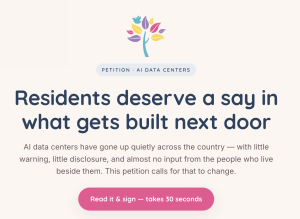
There is so much to be concerned about when it comes to AI data centers and surveillance cameras. It is an infringement on our privacy and a violation of the Fourth Amendment. The cameras can read our license plates (not always accurately) and it can create a profile of the car, its occupants, the electronic signature, all the dings on the body of the car, and where it goes. Then the data is stored in these data centers. Is that what we want for our future—a surveillance state like China? We are at a critical point now and it is important to stop this speeding train in its tracks. At a minimum, sign a petition, send letters to your representatives, and vote out politicians unwilling to stand for our freedom and privacy. The World Council for Health of New England has started a petition. It can be accessed at the link below.